AUSTRALIA'S UNQIUE FROGFISHES
by Nigel Marsh
Many divers travel to Indonesia and the Philippines in the hope of seeing frogfish. Loved by divers, around fifty species of these weird and wonderful fish have so far been described. However, if you would like to see some really unique and usual frogfish you need to head to Australia, as the nation is blessed with the largest variety of these cute fish, including more than a dozen species that are endemic and only found Down Under.
Frogfish are found in both tropical and temperate waters around Australia. Researchers have identified twenty-eight species of frogfish in Australian waters, including most of the tropical species that are popular in Indonesia and the Philippines, like the Hairy Frogfish, Painted Frogfish, Giant Frogfish and Warty Frogfish. However, Australia also has thirteen species that are endemic and unique, and these are the species that this article is going to cover.
FROGFISH VS ANGLERFISH
Before we look at the unique Aussie frogfish, they seem to have a bit of a naming issue in Australia, with some calling them frogfish and others anglerfish. So what is correct?
Well, this depends on who you talk to, in my opinion frogfish is correct. This is because the name anglerfish is used to cover the entire teleost order Lophiiformes, which contains eighteen families of fish that all typically have a head lure to attract prey. Anglerfishes come in a wide variety of shapes and sizes, some are pelagic, some live in deep water and some bury in the sand. Other anglerfish families include the handfish, prickly seadevils, warty seadevils and monkfish.
Of all the anglerfish families, the frogfish (family Antennariidae) are the ones most loved by divers. Like other anglerfish, they are ambush predators, using their camouflaged skin colours and fleshy filaments to conceal their presence. They suck down fish and crustaceans that are attracted by flicks of their head lure. These remarkable fish have hand-like fins, so walk across the bottom, rather than swim. Frogfish don’t move around much, so are often seen in one location for months. They are also short lived, with most small frogfish only living one to two years, and larger species up to five years.
Whether you call them frogfish or anglerfish, everyone agrees these weird little fish are very special and an encounter with one always makes a dive more memorable. The only problem can be finding them. Most of the tropical species that are mentioned above are camouflaged and difficult to spot, and they are the more obvious ones. However, finding the endemic Australian species is much harder, as not only are they well camouflaged, but some are small and others hide completely out of sight.
Of the thirteen unique Australian frogfish I have only encountered five species, and not for want of looking. So let me tell you about the ones I have been able to find.
IMAGE BELOW - RED-FINGERED FROGFISH
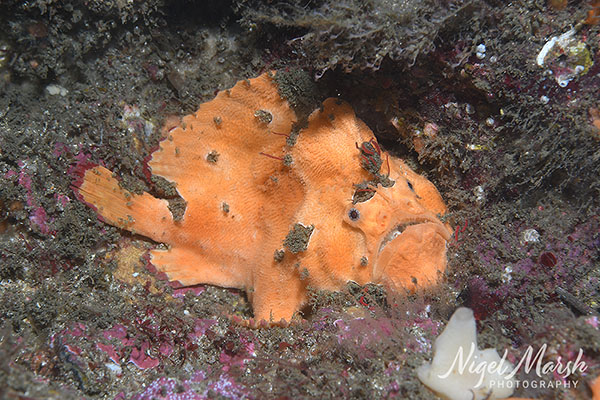
RED-FINGERED FROGFISH
One of the first frogfish I ever encountered was the Red-fingered Frogfish (Porophryne erythrodactylus). This was back in the 1980s when I lived in Sydney and regularly dived Botany Bay. At that time, I had only seen one other species, the Hairy or Striate Frogfish (Antennarius striatus) at other sites in Sydney, and it was a well-known species. However, when I saw this strange looking frogfish with red-tips on its fins I didn’t know what it was. I couldn’t find the frogfish in any guidebook at the time, and that was because it wasn’t described until 2014!
It is now known that the Red-fingered Frogfish is only found in New South Wales, between Sydney and Jervis Bay. However, the only place where they are regularly seen is at Kurnell and Bare Island in Botany Bay. The Red-fingered Frogfish looks very similar to the sponges that decorate the reefs in this area, and most are either grey or orange in colour. They grow to 7.5cm long, and though small they are one of the easier species to find, as they sit out in the open next to similar coloured sponges and algae.
IMAGE BELOW - TASSELLED FROGFISH
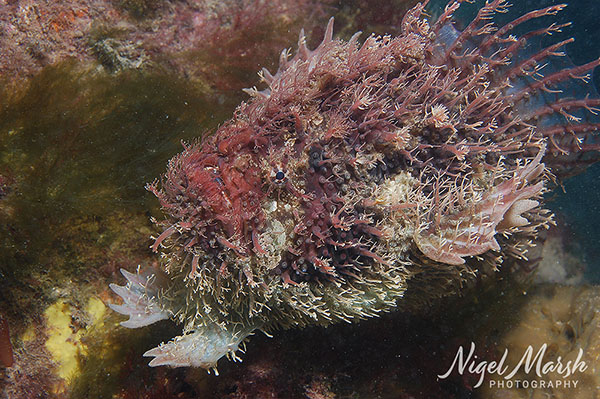
TASSELLED FROGFISH
One of the most highly camouflaged members of the frogfish family is the bizarre Tasselled Frogfish (Rhycherus filamentosus). This frogfish is covered in the most elaborate fleshy growths, that exactly matches the shape and colour of the red algae it likes to sit on. The Tasselled Frogfish grows to 23cm in length, and considering their size and their habit of sitting on exposed algae you would think it would be an easy species to find. However, its camouflage is so good that most divers swim straight passed these frogfish.
The Tasselled Frogfish is a temperate species, like most of Australia’s endemic frogfish, and is only found off South Australia, Victoria and northern Tasmania. Within that area they are locally common, with the best places to find one being under one of the many jetties of South Australia or under one of the piers in Port Phillip Bay. I have found them a very difficult and elusive frogfish to find. Over six dive trips to the area where they live, I have only managed to find one at Blairgowrie Pier, south of Melbourne.
IMAGE BELOW - WHITESPOTTED FROGFISH
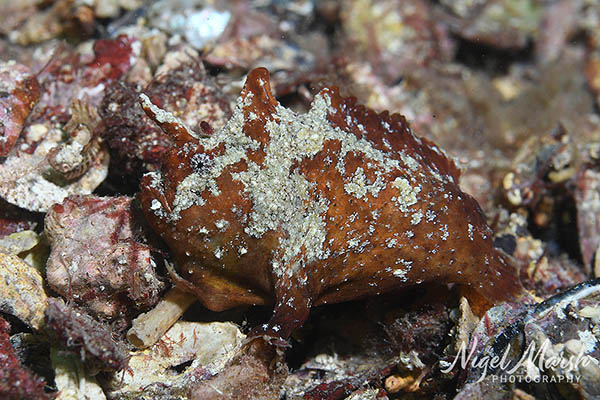
WHITESPOTTED FROGFISH
The Whitespotted Frogfish (Phyllophryne scortea) is a very cryptic member of the family, that likes to hide under rocks, old shells and other debris. This makes them incredibly difficult to find. The Whitespotted Frogfish grows to 10cm in length and can be coloured white, grey, yellow, orange, brown or black, whatever colour helps it blend into its surrounds. Some have white spots or blotches, hence the name, while others are spotless. The Whitespotted Frogfish has two large dorsal spines on its head that look like fleshy horns. And its lure looks like an amphipod, which its uses to attract gobies to prey on.
The Whitespotted Frogfish is a temperate species, reported to be found off southern New South Wales through to South Australia. However, most divers encounter them under a few special jetties on the Yorke Peninsula. On my first dive trip to the Yorke Peninsula I couldn’t find one of these secretive little fish. However, on a recent visit I found eight Whitespotted Frogfish over five dives, under Edithburgh Jetty and Port Hughes Jetty.
IMAGE BELOW - PRICKLY FROGFISH
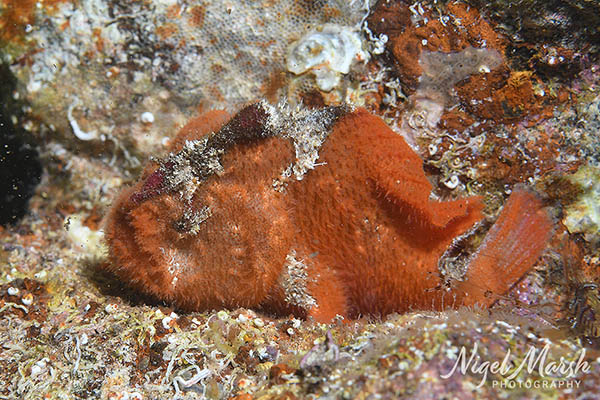
PRICKLY FROGFISH
The Prickly Frogfish (Echinophryne crassispina) is one of the smallest endemic frogfish, only growing to 7cm long. This is another secretive species that likes to hide, so encounters are few and far between. The Prickly Frogfish has a distinctive prickly skin, formed by spinules over its body. This species is often a red or orange colour with patches of lighter marbling on its head or body.
A temperate species, the Prickly Frogfish is found off South Australia and Victoria, and possibly off Tasmania and southern New South Wales. This is another species of endemic frogfish that is mostly seen under jetties, hiding under rocks and debris. I have only found one Prickly Frogfish, and it was at the best place to see one, under the always brilliant Edithburgh Jetty.
IMAGE BELOW - GLAUERT'S FROGFISH
GLAUERT’S FROGFISH
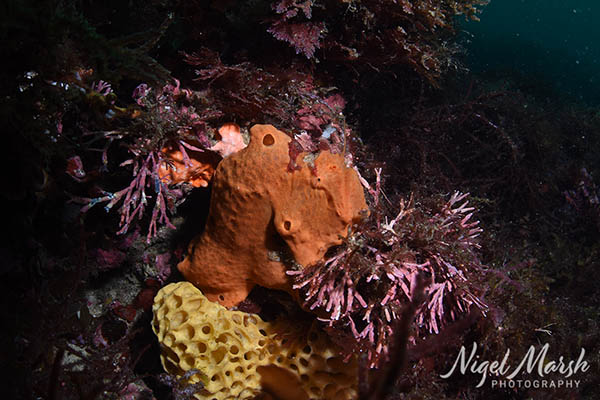
The strangest and rarest Aussie frogfish I have so far found is the very weird Glauert's Frogfish (Allenichthys glauerti). I was diving a reef off Bunbury, Western Australia, that was covered in seaweeds and sponges when I found a sponge with an eye. Now sponges typically have several holes to filter water, and several frogfish mimic this look, developing hole-like patterns on their skin. For almost a minute I closely studied this sponge, slowly working out that it had a mouth, fins and a head lure. It finally dawned on me that I had found the elusive Glauert’s Frogfish.
The Glauert’s Frogfish is only found off southern Western Australia and South Australia, though most sightings have been between Busselton and Perth. This species mostly mimics sponge, but I have seen photos of one that had the same colour and pattern as an ascidian. The Glauert’s Frogfish grows to 19cm long, and very confident of its camouflage, they boldly sit in sponge gardens waiting for small fish to get close so they can be snatched.
With eight more unique Aussie frogfish still for me to find and photograph, I know I will have many interesting Australian dive adventures in the coming years looking for these weird and wonderful fish.