THE MACRO SIDE OF PALAU
by Nigel Marsh
Palau is one of the most outstanding all round dive destinations in the world. The island nation has wonderful reefs, amazing ocean caves, healthy shark numbers, impressive schools of pelagic fishes and an incredible collection of World War II wrecks to explore. It is a brilliant location for wide-angle photography; but is it equally great for those that love macro photography?
The Republic of Palau is a small island nation in Micronesia, located north of Papua New Guinea and east of the Philippines. It is the fourth smallest country in the world, made up of 340 islands and home to some of the richest coral reefs on the planet. I first visited Palau in 1990 and was stunned by the beauty of the place, above and below the water line. On that trip, with my trusty old Nikonos V and 15mm lens, I concentrated on the endless wide-angle opportunities, and I only swapped to the macro lens on a handful of dives.
Since my first visit to Palau a great deal has changed. Palau become an independent nation in 1994, it also protected most of its reefs, as well as its fishes and turtles. And in 2009 the nation declared its waters the world’s first shark sanctuary.
Keen to return, especially with direct flights now available from Australia, I organised to take a photography group on the liveaboard Ocean Hunter III in September. It proved to be a wonderful choice, with this spacious vessel accommodating 16 guests in eight very comfortable ensuite cabins. Ocean Hunter III is a brilliantly configured liveaboard with a large camera setup area, a sundeck with two spas and a well laid-out lounge and dining area. The meals were a treat that never left you wanting more, and the crew were excellent, looking after our every need on the boat and underwater.
For our first dives at Ulong Sand Bar, Ulong Wall and Siaes Corner, I was happy to take the wide-angle lens for the schools of fish, reef sharks and pretty corals. Then with a return to Ulong Wall in the afternoon it was time to get the 60mm macro lens out. Slowly drifting along this wall, I found numerous pretty reef fishes and invertebrates to photograph.
IMAGE BELOW - TOMATO CORAL GOBY
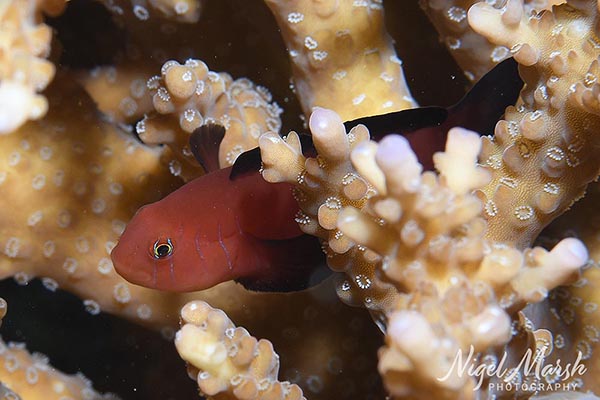
I found the best macro subjects in the coral garden at the top of the wall, including a pair of lovely harlequin filefish as they weaved among the coral branches. With so many healthy hard corals in this area, I also had a look for coral crabs and was hoping to see a few coral gobies. These tiny fish are extremely shy and always a challenge to photograph and I was rewarded with a small group of tomato coral gobies; the first time I had seen this species.
The next morning, we headed out to Palau’s most famous dive site Blue Corner. Having done this site numerous times, and getting wonderful wide-angle images of the sharks, schooling fishes and corals, I thought it was a perfect time for something different with the macro lens. While the others hooked in and watched the sharks, I explored the reef top. This area, with its many coral heads, was overloaded with reef fish, including pygmy angelfish, giant morays, wrasses, parrotfishes, butterflyfishes and coral snappers.
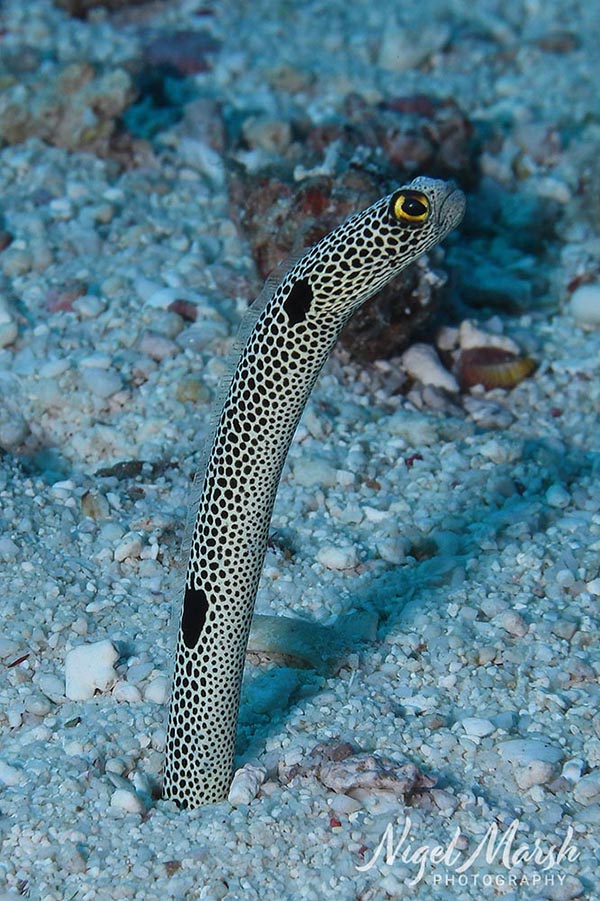
I was looking for something special and found it in a sandy gutter – hundreds of spotted garden eels. Usually, garden eels are very hard to get close too; however, this colony appeared to be used to divers or maybe they just liked me, as many allowed me to get very close for photos. I then topped this by getting some good photos of another usually shy fish, the zebra-barred dart gobies. These fish are rarely seen, and when you do find some they are very elusive. Lucky for me, the ones at Blue Corner were bold and very photogenic.
Enjoying all the macro subjects, I kept the 60mm lens on for the rest of the day. At Blue Holes I by passed the incredible vistas to explore the nooks and crannies, photographing banded pipefish, triggerfish, angelfish, nudibranchs and a disco clam. At New Dropoff I photographed hawkfish, rabbitfish, surgeonfish and turtle faces. While at Big Dropoff I pointed my camera at corals crabs, cleaner shrimps, sea whip shrimps and a juvenile yellow boxfish.
BELOW - SPOTTED GARDEN EEL.
Between dives, when not eating and relaxing, we were constantly entertained by the dozens of blacktip reef sharks that swam around the boat at our mooring in the lagoon. At times they were joined by schools of trevally, numerous free-swimming remoras and a few pink whiprays on the sand below. At night the lights at the back of the boat attracted plankton, small fish and many larger fish feeding on this bonanza of food. We were also lucky enough to have two reef manta rays join in the fray, doing somersaults at the duckboard as they gobbled up plankton.
For our visit to the reefs off Peleliu I switched back to wide-angle to photograph the sharks, turtles and schools of fish at Peleliu Express and Peleliu Wall. I also kept the wide-angle on for the reef manta rays at German Channel. In the late afternoon I was glad to return to macro for a dive at Turtle Cove. With dark and gloomy conditions, it was almost a night dive as we explored the wall and its many caves. I photographed longnose hawkfish, a slipper lobster, morays, basslets and hinge-beak shrimps. My best find was in the back of a cave when I stumbled on a very strange looking fish I had never seen before. Transparent, with a large head and eyes, it looked like a cross between a jawfish and cardinalfish. I finally identified it as a glassy cardinalfish.
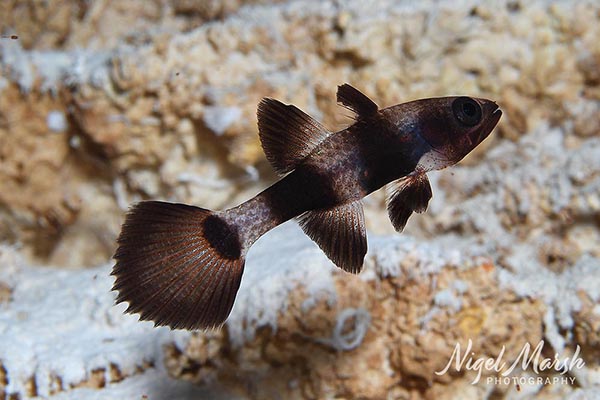
I found another strange cardinalfish the next morning on a dive at Virgin Blue Hole. This spectacular L-shaped cave is made for wide-angle photography, but once more I had on the 60mm lens and photographed dart gobies, angelfish, tilefish, rock cods and wrasse. Exploring a side passage, I was very excited to find a small group of paddlefin cardinalfish, another rarely seen fish.
Buoyed by this find, I kept the macro lens on for the rest of the day. At Dexter Wall I photographed mouth mackerel, boxfish and clown triggerfish. At German Channel it was shrimp gobies, rock cods, glider gobies and grubfish. While a return to Blue Corner had me snapping photos of blue tangs, fusiliers, morays and more spotted garden eels.
With our trip timed to coincide with the bumphead parrotfish spawning, I opted for the wide-angle lens for an early morning dive at Ulong Sand Bar. While we saw the spawning from a distance, we were never close enough to get a photo. I reattached the macro lens for the next dive at Siaes Tunnel, as this site has some great macro subjects.
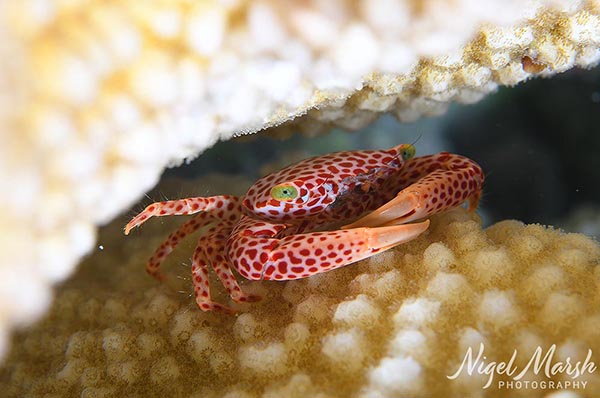
IMAGE BELOW - CORAL CRAB.
One of the largest ocean caves in Palau, Siaes Tunnel has a rubble and sandy floor which is a great spot for nudibranchs, shrimp gobies and dart gobies. With assistance from dive guide Ace, we quickly found flagtail shrimp gobies, red dart gobies and purple dart gobies. Unfortunately, the fish I most wanted to see, the rare Helfrich’s dart goby, eluded me. I then moved onto the walls of this cavern to look for the rarely seen Cocos-Keeling angelfish and was lucky enough to see two of these small fish.
After a fast-paced drift dive at Ulong Channel, which didn’t offer too many macro subjects, I was happy that the afternoon dive was at Siaes Corner. This is the best spot in Palau to see gorgeous flame angelfish, and it didn’t disappoint. I also found tiny coral hermit crabs, morays, goatfish, hogfish and yellowhead dwarf gobies. While on our safety stop, I looked among the branches of the hard corals for more coral gobies when I spotted something even rarer, a spotted croucher.
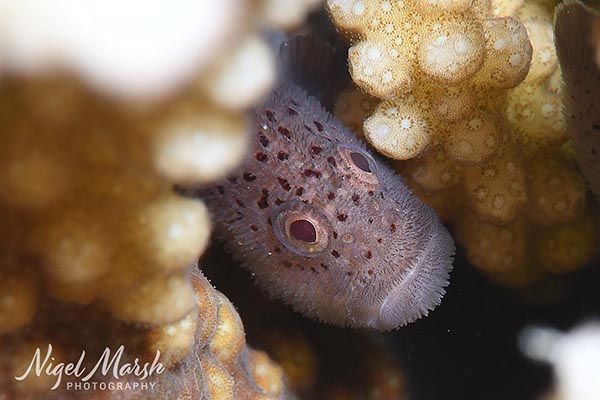
I have always wanted to photograph this rare member of the scorpionfish family that hides in hard corals, and before me were at least three of them. The only problem was they were deep in the coral and never stopped moving around. After shooting several dozen images, most out of focus or only capturing part of a fin or tail, I finally nailed one head portrait of these strange little fish.
After four dives each day I was generally happy to rest after the sunset and miss the night dives. However, I finally found some extra energy for a night dive at Ulong Reef. While not a pretty spot, being inside the lagoon, there was a great range of macro subjects for my camera. There were lots of prawns out crawling over the coral or swimming in the water column, plus a good variety of shrimps, crabs, cardinalfish, lionfish and sea stars.
IMAGE BELOW - PADDLEFIN CARDINALFISH.
The next morning was our last day of diving, so it was time to explore the Japanese shipwrecks from World War II. Our first dive was the famous Iro, a 140m long navy fleet oiler. I have dived this ship several times with the wide-angle lens, so thought it would be a nice change to see what macro-options it offered. Being a fish nerd, I found no shortage of subjects, with a wonderful range of damsels, butterflyfishes, fusiliers, rockcods, wrasses, rabbitfishes, triggerfishes and parrotfishes. The highlights for me were all the grey-tail angelfish, a species I had only seen once before in Papua New Guinea.
I stuck with macro for the next wreck dive on the Teshio Maru, a 100m long cargo ship. This ship had even more macro subjects, including nudibranchs and a good variety of blennies. We also found several sea whip shrimps and a delicate sawblade shrimp.
The wide-angle lens went back on for the final dive at Chandelier Cave. This cave never fails to impress with its stalactites and four air pockets. I am sure there are a few macro critters hidden in its recesses, but these will have to wait for another trip.
Returning to port after a brilliant week of diving in Palau, I was more than happy with my decision to concentrate on macro in one of the best wide-angle destinations in the world.
IMAGE BELOW - CORAL CROUCHER.