WIDE-ANGLE DREAM SUBJECTS IN RAJA AMPAT
by Nigel Marsh
Before every dive trip I always have a list of dream subjects. Most of these subjects are new, species I have never photographed before. However, when returning to destinations I have dived before I also have subjects that I want to improve on. Recently I returned to Raja Ampat, Indonesia, and I had a chance to tick off some dream wide-angle subjects at this very special dive destination.
I first visited Raja Ampat in 2017 and followed this up with a return trip in 2018. On both trips I explored the area’s rich waters on a liveaboard vessel operated by Sea Safari Cruises. Raja Ampat amazed me from the very first dive, with stunning reefs, beautiful corals, masses of reef and pelagic fishes, plus the occasional turtle, shark and reef manta ray. On these trips I was constantly swapping between the wide-angle and the macro lens, shooting schools of fish, fish portraits, stunning corals, fascinating invertebrates, camouflaged wobbegongs and even muck critters.
I thought I had the area covered and wasn’t planning on a return trip until an email from the Indonesian Ministry of Tourism arrived inviting me to join a familiarization trip with a group of Australian dive travel agents. The week-long trip would see us staying at a resort at Katembe Private Island and diving some of the best dive sites in Raja Ampat.
I naturally said yes and then reviewed my previous images to see what I had missed and what I could improve on and quickly came up with a list of dream wide-angle subjects. These included a tasselled wobbegong resting on a plate coral and a large school of ribbon sweetlips were key subjects. While I had photographed these subjects on previous trips, the wobbies were always hidden under a ledge and I only found small groups of ribbon sweetlips. I also hoped to get a few reef shark images; however, top of my list was an oceanic manta ray. This is a species that has eluded me for many years. On my previous trips to Raja Ampat, I had seen several reef manta rays, but the oceanic manta rays where nowhere to be seen. With these subjects in mind, I packed my gear and headed off to Indonesia.
Getting to Raja Ampat is a lengthy adventure, even from Australia. We flew Sydney to Jakarta, then flew overnight to Sorong, followed by a two-hour local ferry to the town of Waisa and finally a 30-minute boat ride to the resort. Over twenty-four hours of travel. However, it was well worth the effort when we saw the resort with its white sandy beaches, swaying palm trees and thatched bungalows built over the water. The resort was fabulous, with great staff, amazing food and a wonderful dive operation. However, a little limited for an underwater photographer, as they had little fresh water for showering and washing gear, and limited power, with the generator only working for 12 hours each day. Fortunately, I managed to wash my camera gear and keep my batteries charged daily. I was later informed that the other part of the resort, which will reopen in 2026, has freshwater and 24-hour power.
IMAGE BELOW - TYPICAL REEF SCENE.
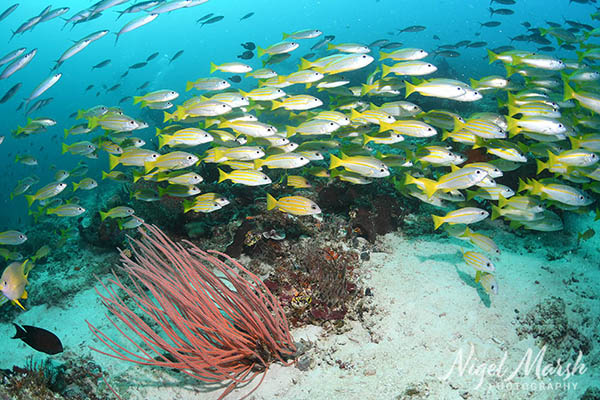
I started looking for my dream wide-angle subjects from the first dive at Mioskon. This lovely sloping reef site is typical of many sites in Raja Ampat, with lovely gorgonians, soft corals, whip corals, sponges and a healthy population of reef and pelagic fishes. I snapped images of schools of coral snappers and batfish, plus crocodilefish, angelfish, pufferfish and a few lone sweetlips.
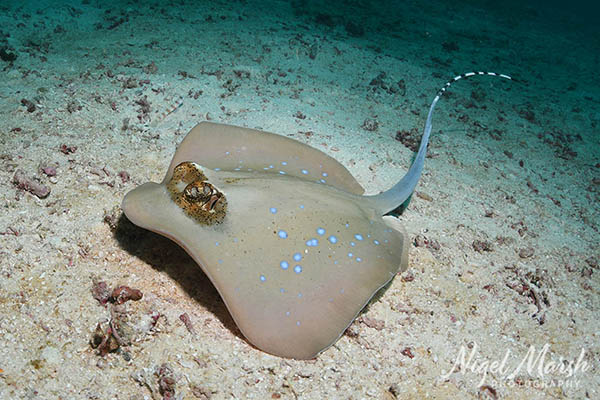
A big surprise at the start of this dive was a group of three Moluccan Bluespotted Maskrays. On my previous trips to Raja Ampat, I had hoped to see stingrays, but hadn’t seen one, so these had slipped off my dream list. This species is only found in this area of Indonesia, identified after DNA testing confirmed that what was once thought to be one widespread bluespotted maskray species is actually a dozen local varieties. I got some lovely photos of these co-operative rays as they rested on the sand.
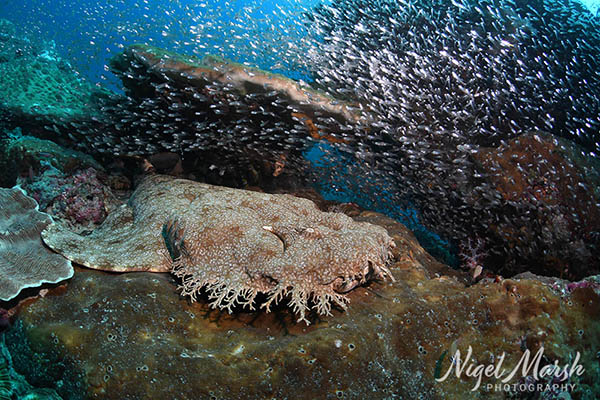
Towards the end of the dive our guide Cliff found a tasselled wobbegong shark, unfortunately, once more resting under a ledge. While I have hundreds of images of these camouflaged sharks, which are also found in Papua New Guinea and northern Australia, the ones in Raja Ampat are unique as some are bold enough to rest in the open on plate corals. This unusual behaviour is what I hoped to capture on this trip.
BELOW - MOLUCCAN BLUESPOTTED MASKRAY.
The next dive at Friwen Wall was also wonderful with pelagic fishes, lovely corals and a great collection of reef fishes. The only subject from my dream list was a blacktip reef shark, that was very shy and impossible to photograph. On this trip I was surprised by the number of blacktip and whitetip reef sharks I saw, a big increase from previous trips. I was also delighted to see over a dozen juvenile blacktip reef sharks cruising around in the shallows in front of the resort.
For the afternoon dive at Batu Lima, I switched to macro to look for smaller subjects. Being a fish nerd, I always have a dream list of fishes I wish to photograph on each trip. I didn’t find anything that was new to me, but still had a lovely dive photographing angelfish, blennies, tuskfish, dottybacks, butterflyfish, anemonefish, tobies and a shortpouched pygmy pipehorse.
It was an early start the next morning for our dive at Blue Magic. This is one of the most famous dive sites at Raja Ampat, a large coral mound rising from 35m to 10m that swarms with fish. I was looking forward to returning to this site as it is often visited by oceanic manta rays. A popular dive site, we had to book a time for our visit, with 7am our allotted slot.
Washed by strong currents, we enjoyed an actioned packed dive seeing schools of barracuda, trevally, fusiliers, coral snappers and batfish. We also spotted blacktip and whitetip reef sharks, Spanish mackerel and numerous reef fishes. I found another tasselled wobbegong, naturally resting under a ledge. Unfortunately, no oceanic manta ray today.
We then headed to my favourite dive site at Raja Ampat, the amazing Sawandarek. This site had changed a lot in seven years; there was a second jetty and the village had grown. Fortunately, it is still a spectacular dive site.
This site has a sloping reef and a massive patch of cabbage coral at 25m that is overloaded with coral snappers and squirrelfish. The last time I dived it there was also a small school of ribbon sweetlips hovering here, but they had moved on. Drifting along the reef I photographed green turtles, barracuda, gropers, maskrays, batfish and a massive school of bigeye trevally. We found another tasselled wobbegong under a ledge, still not that dream shot.
Under the jetty was a lovely mixed school of sweetlips and coral snappers, plus lots of sergeant majors and drummers. While still an incredible dive, I was saddened to see the giant clams that once sat under the jetty had disappeared, and the hard corals around the jetty were showing a lot of wear and tear, not like the healthy coral gardens I had seen on my last visit.
IMAGE BELOW - TASSELLED WOBBEGONG.
The afternoon muck dive at Sapokren was very enjoyable. Switching back to macro I photographed common seahorses, nudibranchs, waspfish, stingfish, commensal shrimps, porcelain crabs, pipefish, pufferfish and marble snake eels.
In the morning, I had the wide-angle lens back on for a dive at Arborek. I had dived this sloping reef and jetty several times on previous trips, so didn’t have high expectations for a return visit. However, the site really surprised me with its lovely corals and abundant fish life. I found another tasselled wobbegong, once more resting under a ledge. However, this one had a cloud of glassfish swarming around that made for some special images. We also saw batfish, angelfish, fusiliers, coral snappers and a Maori wrasse.
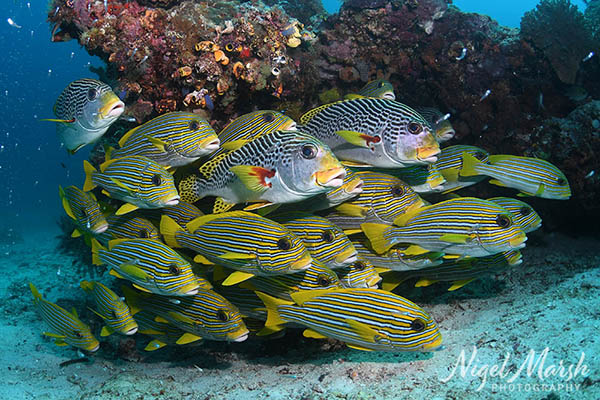
The big surprised came just as our guide indicated to turn around, an impressive school of ribbon sweetlips. Schools of these fish are one of the signature features of this area, and I was very pleased to finally get a chance to photograph a tight ball of at least forty of these colourful fish. They lined up perfectly for my camera and I snapped off almost one hundred images as they milled in front of me. I had finally ticked off one of my dream wide-angle images for this trip.
IMAGE BELOW - RIBBON SWEETLIPS.
Manta Sandy was a let-down after this lovely dive. I have dived this site before and find it very limiting for manta encounters. The site is setup with a stone strip, where divers kneel to watch the mantas, but with it 8m away from the bommies where the mantas get cleaned it is hardly a photographers dream. On this dive we only had 10m visibility and no mantas, and with nothing else to see it was a dull dive.
For the next three dives at East Friwen, Batu Rufus and Melissa’s Garden I went with the macro lens for fish portraits. This ended up being a good choice for these sites, with a great range of boxfish, angelfish, tobies, blennies and wrasses. The highlights being a comet, a winged pipefish, a Morrison’s dragonet and a Denise’s pygmy seahorse.
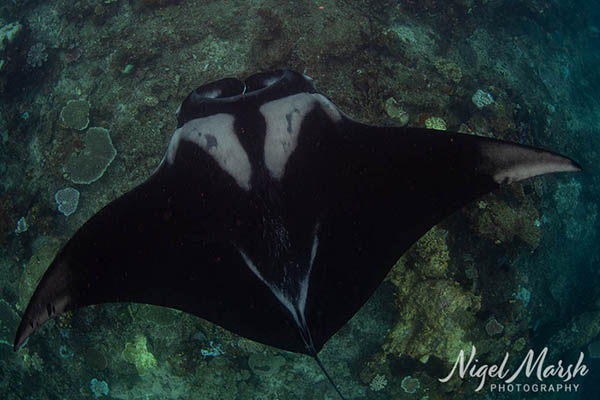
Our final morning gave us one last chance to visit Blue Magic. We were once again booked into the 7am time slot and woke to find an overcast grey day. It was dark and gloomy underwater, and for the first forty minutes I photographed barracuda, trevally and schools of soldierfish. I found the tasselled wobbegong once more, still resting under the same ledge and was busy photographing it when our guide Cliff started waving and pointing into the blue. I charged over and was delighted to see a large shape swimming towards us, finally an oceanic manta ray.
For the next twenty-five minutes this majestic 4.5m wide ray swam around us getting cleaned. It appeared to be very curious of our small group, heading straight at us and banking away at the last minute. Several times it swam straight over my head, allowing for some great photos.
At one point I was hovering above a small coral outcrop when the manta turned directly towards me. I couldn’t believe my luck when the ray kept coming closer and closer. I expected it to turn off at any second, but then something completely unexpected happened, the ray went under me. I was hovering in a horizontal position, so must have appeared to be a lot smaller to the manta for it to make this manoeuvre. I couldn’t believe it, there must have only been a two-metre gap between me and the coral head, but the ray squeezed through, only centimetres below me. I got some amazing photos, a dream wide-angle subject finally ticked off.
On the long journey back home to Australia I reflected on a great trip to Raja Ampat. I had ticked off two of the dream wide-angle subjects and had a close encounter with an oceanic manta ray that I will never forget!
IMAGE BELOW - OCEANIC MANTA RAY.